How to Check Your Car’s Refrigerant Level
Wondering how to check your car’s refrigerant level? You are not alone. When the air coming from the vents turns warm during a San Antonio afternoon, it is natural to think the system may simply need more refrigerant. The truth is a little more precise: automotive air conditioning refrigerant is not checked like engine oil or coolant. It is part of a sealed, pressurized system, so the best first step is understanding the signs of a low charge and knowing when professional auto AC repair in San Antonio is the safer path.
At Eurasian Auto Repair, we help drivers get clear answers before approving repairs. Our ASE-certified technicians use diagnostic equipment to evaluate refrigerant pressure, temperature performance, leaks, electrical controls, and compressor operation before recommending an AC recharge or repair. That approach matters because warm air does not always mean low refrigerant. A failed fan, restricted airflow, weak compressor, electrical fault, or sensor issue can create similar symptoms.
This guide explains what you can safely check at home, what the warning signs may mean, and why a proper AC diagnostic can save time, protect your vehicle, and help you avoid adding refrigerant when the real problem is somewhere else.
Can You Check Car AC Refrigerant Level Yourself?
You can check for signs that your car may be low on refrigerant, but you usually cannot confirm the exact refrigerant level without professional equipment. Vehicle AC systems are sealed and pressurized, and the correct charge is based on a specific refrigerant weight listed by the manufacturer. A shop does not simply guess by pressure. The refrigerant should be recovered, measured, leak tested when needed, and recharged to the correct specification.
Many store-bought recharge kits use a single low-side gauge. That can sometimes make the process look simple, but pressure readings can change based on outside temperature, system design, humidity, compressor cycling, and airflow across the condenser. A pressure reading that appears low may not tell the full story. In some cases, adding refrigerant can overcharge the system, which may reduce cooling performance and place extra strain on the compressor.
There is also an environmental and safety side to consider. Refrigerant must be handled carefully, and professional technicians who service vehicle air conditioning systems for compensation must follow EPA motor vehicle AC requirements and Section 609 certification rules. For drivers, the practical takeaway is simple: you can look for clues, but refrigerant service should be handled with the right tools, training, and recovery equipment.
Signs Your Car May Be Low on Refrigerant
A low refrigerant charge often starts as a comfort issue, then becomes more noticeable as temperatures rise. If your AC cools slightly in the morning but struggles later in the day, that may be a sign the system is not performing at full capacity. In the San Antonio heat, even a small AC issue can feel much worse during stop-and-go traffic. Pay attention to when the cooling changes. Symptoms that appear only at idle, only in traffic, or only after a long drive can help a technician narrow the diagnostic path.
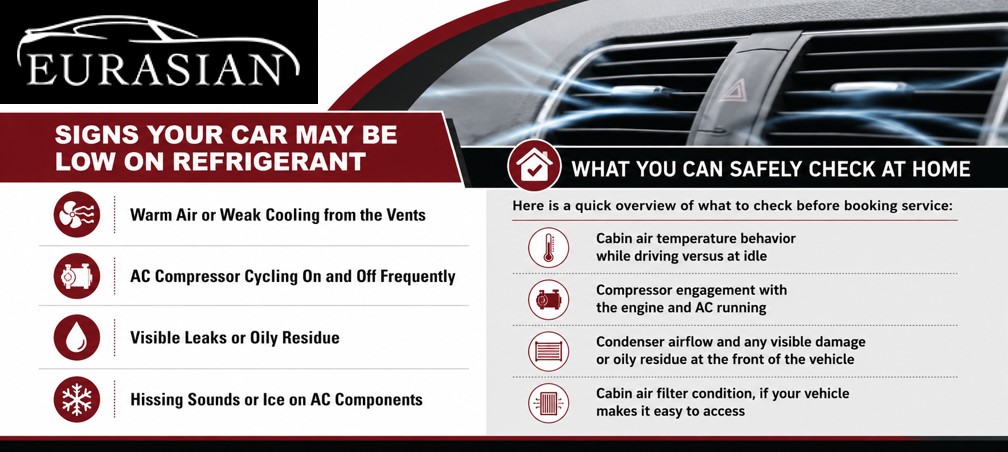
Warm Air or Weak Cooling from the Vents
The most obvious symptom is air that does not feel cold enough. You may notice the AC starts cool, then becomes warmer, or that one drive feels fine and the next does not. Low refrigerant can cause weak cooling because the system does not have enough refrigerant to absorb and release heat properly. Still, warm air can also point to a compressor, blend door, fan, condenser, or electrical issue, which is why diagnostics matter.
AC Compressor Cycling On and Off Frequently
If the compressor clutch cycles rapidly or the AC seems to cut in and out, the system may be protecting itself from abnormal pressure. Low refrigerant can trigger that behavior, but so can a pressure sensor issue or poor airflow. This is one reason a technician will look at the full operating picture rather than relying on one symptom.
Visible Leaks or Oily Residue
Refrigerant leaks often carry a small amount of oil with them. If you see oily residue around AC hoses, fittings, the compressor, condenser, or service ports, the system may have a leak. You may also notice stains near the front of the vehicle where the condenser sits. Do not disconnect AC lines or press service valves to test the system. That can release refrigerant and create an avoidable risk.
Hissing Sounds or Ice on AC Components
A hissing sound near the AC system can be related to normal pressure equalization after shutdown, but persistent hissing may suggest a leak or restriction. Ice formation can also happen when system pressure, airflow, or evaporator temperature is not right. These symptoms should be inspected instead of being covered up with a quick recharge.
What You Can Safely Check at Home
Before scheduling service, there are a few simple checks you can do without opening the refrigerant system. These steps will not confirm the exact refrigerant level, but can help you describe the problem clearly when you talk with a repair team.
Here is a quick overview of what to check before booking service:
- Cabin air temperature behavior while driving versus at idle
- Compressor engagement with the engine and AC running
- Condenser airflow and any visible damage or oily residue at the front of the vehicle
- Cabin air filter condition, if your vehicle makes it easy to access
Start inside the cabin. Set the AC to the coldest setting, turn the fan speed up, select fresh air or recirculation, and pay attention to whether the air changes temperature as you drive. Note whether the problem happens at idle, only in traffic, only at highway speed, or all the time. If the air gets colder while driving but warms up at a stop, the issue may involve condenser airflow, cooling fans, or system pressure rather than refrigerant alone.
Next, listen for the AC compressor. With the hood open and the engine running, you may hear or see the compressor engage when the AC is turned on. Keep hands, clothing, and tools away from belts and moving parts. If the compressor never engages, low refrigerant is one possible cause, but an electrical fault, relay, pressure switch, or compressor issue may also be involved.
You can also inspect the front of the vehicle for blocked airflow. Leaves, plastic bags, road debris, or a damaged condenser can reduce cooling. If the condenser is visibly damaged or oily, that is worth mentioning when you schedule a car diagnostic in San Antonio. Finally, check whether the cabin air filter is clogged if your vehicle makes it easy to access. Restricted airflow can make the AC performance feel weak even if the refrigerant charge is correct.
Why Low Refrigerant Usually Means There Is a Leak
A healthy AC system should not use up refrigerant the way an engine uses fuel. Refrigerant circulates through a sealed loop. If the charge is low, there is usually a leak somewhere, even if it is small. Adding refrigerant without finding the leak may provide temporary cooling, but it rarely solves the underlying problem.
Leaks can develop at hose crimps, O-rings, service ports, condensers, evaporators, compressors, or damaged lines. Some leaks are obvious. Others only appear under pressure, with dye, an electronic leak detector, or during a deeper inspection. That is why a careful diagnostic process is important, especially on European and Asian vehicles, where system design and refrigerant capacity can vary widely by model.
A quick example: a driver may come in after adding refrigerant from a parts store because the AC stopped cooling. The system blows cold for a day, then warms up again. During inspection, the actual problem turns out to be a small condenser leak caused by road debris. In that case, another recharge would not be the right repair. The leak needs to be addressed, the system evacuated properly, and the correct refrigerant charge added afterward.
The same logic applies when a cooling concern overlaps with engine temperature problems. If your vehicle is overheating, losing coolant, or showing temperature warning lights, the issue may involve the engine cooling system rather than the AC system. In that situation, our cooling system repair service can help identify whether the problem is related to coolant flow, fans, radiator condition, or another heat-management concern.
Why DIY Recharge Kits Can Create New Problems
Recharge kits are popular because of the perceived convenience, but these DIY kits can create problems when the system has not been diagnosed first. If the AC is not cooling because of an electrical issue, a failed compressor, a restricted condenser, or a faulty fan, adding refrigerant will not fix the cause. If the system is already properly charged, adding more can make performance worse.
Overcharging can raise system pressures and place additional load on the compressor. Some kits also include additives or sealers that may not be appropriate for every vehicle. These products can complicate future repairs and may affect service equipment. For vehicles with specialized systems, including many European, Asian, hybrid, and late-model vehicles, guessing can become expensive quickly.
The safest approach is to treat refrigerant as part of a full AC system, not a standalone fluid to top off. A proper service checks pressure readings, temperature output, compressor command, fan operation, leak indicators, and system capacity. That gives you a clearer answer and a repair plan based on what the vehicle actually needs.
How Eurasian Auto Repair Diagnoses Refrigerant and AC Problems
When we inspect an AC concern at Eurasian Auto Repair, our goal is to give you a clear explanation before repair work begins. We start by confirming the symptom, then evaluate system performance using the right diagnostic process for your vehicle. That may include checking vent temperature, high- and low-side pressures, compressor operation, condenser fan performance, electrical controls, and visible leak points.
If the refrigerant charge is low, the next question is why. Depending on the situation, we may recommend leak detection, component inspection, or recovery and recharge to the manufacturer’s specified amount. We also consider vehicle history because a repeat AC recharge usually means something has not been fully corrected.
For San Antonio drivers with BMW, Mercedes-Benz, Audi, Lexus, Toyota, Honda, Porsche, Volkswagen, and other import vehicles, accurate diagnostics are especially important. Many systems are sensitive to charge amount and operating conditions. Our import auto repair team works with European and Asian vehicles every day, while also servicing domestic makes and models.
Once we understand the issue, we explain the findings in plain English. You can review the recommended next steps, ask questions, and decide how you want to move forward. Qualifying repairs may also be backed by our warranty coverage, giving you added confidence after the work is complete.
When to Schedule Auto AC Service in San Antonio
Schedule AC service if your vents blow warm air, cooling fades in traffic, the compressor cycles rapidly, you see oily residue near AC components, or the system needs repeated recharging. It is also smart to schedule service before a long summer drive if your AC has been inconsistent. Small problems are usually easier to address before the hottest part of the season puts the system under heavier demand.
We know car problems can interrupt your day, especially when the cabin will not cool down. With two San Antonio locations, online booking, after-hours options, and customer-friendly conveniences, our team works to make the repair process easier to manage. You can choose the location that fits your routine and get straightforward guidance on what your car needs next.
San Antonio summers put real demand on every component of your AC system. Getting ahead of a problem before peak heat arrives typically means a faster turnaround and fewer complications.
If you suspect your vehicle is low on refrigerant, let us help you confirm the cause instead of guessing. Schedule an auto repair appointment in San Antonio with Eurasian Auto Repair, and our ASE-certified technicians will inspect your AC system, explain the results, and help you get back on the road with reliable cooling and peace of mind.